

Sustainable Water Partner
This ESG Report outlines Nyadha House’s approach, actions, and impact across Environmental, Social, and Governance dimensions. As a micro-enterprise, Nyadha House focuses on practical, measurable, and locally relevant sustainability actions aligned with the SDGs and the principles of the UN Global Compact Network Nepal.
Nyadha House prioritizes passive design, maximizing natural light and ventilation. Energy-efficient appliances and LED lighting are used across the property to minimize consumption.
Initiatives:
Water efficiency is encouraged through refillable water bottles in the room, low-flow fittings and guest awareness practices, including towel and linen reuse options.
Initiatives:
Nyadha House actively works to reduce waste, particularly plastic waste, through mindful procurement and guest amenities.
Initiatives:
We prioritize local sourcing wherever possible- from food ingredients to furnishings- supporting small producers and artisans.
Initiatives:
Guests are informally educated on local environmental challenges and responsible tourism practices. Sustainability messaging integrated into guest interactions rather than enforced policies
Nyadha House employs staff primarily from the local community and rural areas ensuring fair wages, safe working conditions, and respect for work-life balance.
As a woman-led business, Nyadha House actively supports women’s economic participation through employment and procurement.
Initiatives:
Nyadha House collaborates with local guides, vendors, and cultural practitioners, ensuring tourism revenue circulates within the community.
Initiatives:
Nyadha House employs Human-centered guest experience design focusing on safety, comfort, and cultural sensitivity, facilitates Inclusive and respectful environment for guests from diverse backgrounds and emphasizes on meaningful interactions rather than transactional hospitality through continuous feedback.
As a woman-led business, Nyadha House actively supports women’s overall growth and wellbeing.
Initiatives:
Nyadha House follows transparent pricing, honest marketing, and compliance with all local tourism and business regulations.
The business is owner-managed, enabling hands-on oversight, ethical decision-making, and long-term vision aligned with community well-being.
Nyadha House is an active member of UN Global Compact Nepal Network, FWEAN and CNIWLF. and has collaboration with banks, development programs, and sustainability networks and is open to third-party reviews, guest feedback, and partner assessments.
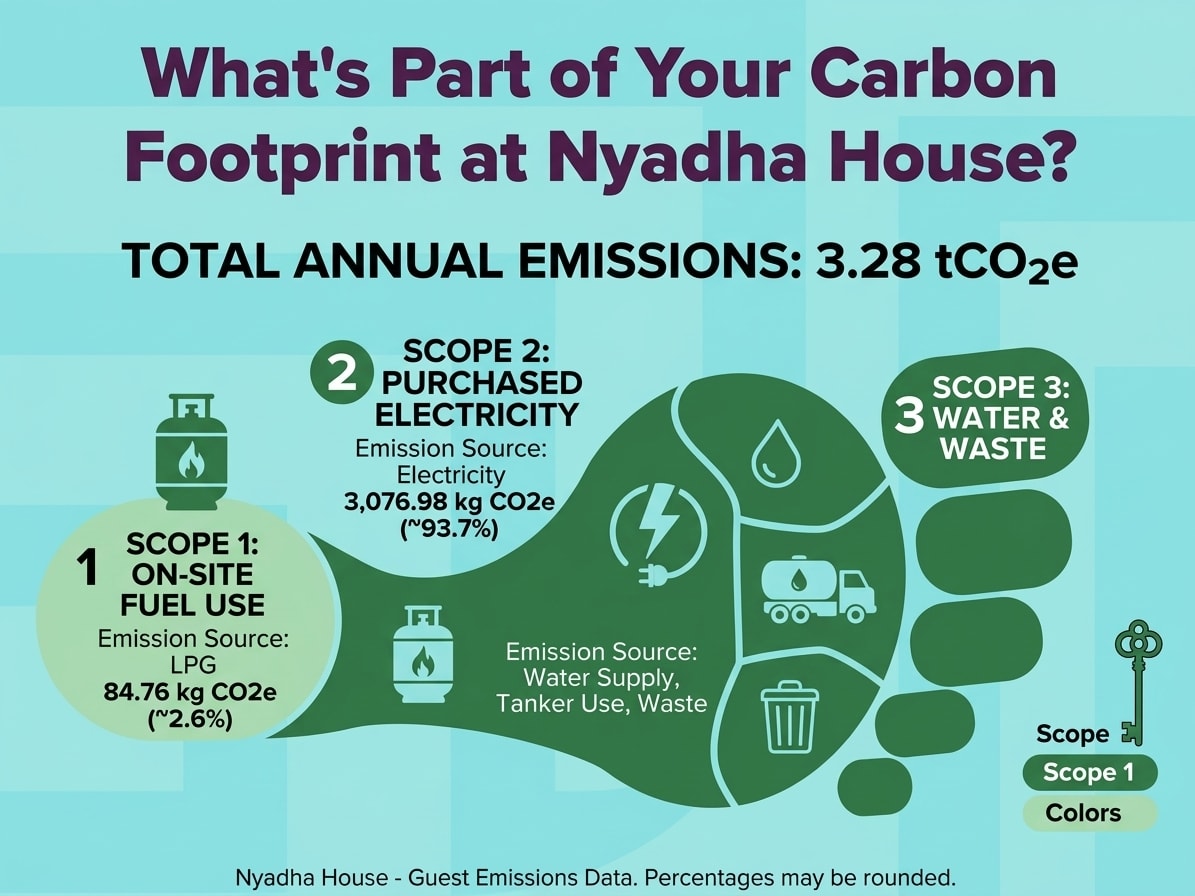
Nyadha House conducted a greenhouse gas (GHG) emissions assessment in line with the GHG Protocol, covering Scope 1, Scope 2, and selected Scope 3 emissions.
3.28 tCO2e
Nyadha House commits to:
Sustainable Water Partner

Sustainable Waste Bag Partner

Bakery Partner
Sustainable Waste Management Partner

Upcycled Pinewood Furnitures

Green Room Amenities



Nyadha House views sustainability as a continuous journey rather than a fixed destination. Building on the foundations established during its initial years of operation, the following commitments outline the next phase of growth focused on deepening impact, improving measurement, and strengthening accountability, while remaining realistic for a small, heritage-based hospitality enterprise.
By 2028, Nyadha House aims to serve as a demonstration model for small, independent hospitality businesses in Nepal, showing that meaningful alignment with SDGs and ESG principles is achievable without large-scale infrastructure.
Nyadha House aspires to be recognized not only as a place to stay, but as a responsible tourism partner contributing to cultural preservation, inclusive economic growth, and environmentally conscious travel in Patan Durbar Square.
Implementing sustainability within a small, independently run heritage hospitality business comes with both practical and contextual challenges. These experiences have shaped Nyadha House’s approach and strengthened its commitment to continuous improvement.
Sustainable materials, ethical sourcing, and locally produced alternatives often come at a higher upfront cost compared to conventional options. As a small business, Nyadha House has learned to prioritize impact-driven choices gradually phasing sustainability initiatives in a way that remains financially responsible while staying true to its values.
Like many micro and small enterprises, Nyadha House faces limitations in collecting detailed quantitative data on environmental and social performance. This has reinforced the importance of starting with simple, qualitative indicators and gradually building internal capacity for impact measurement over time.
Not all guests arrive with the same level of understanding of responsible tourism or heritage sensitivity. Encouraging mindful behavior such as water conservation or respectful engagement with the local community requires gentle communication, storytelling, and continuous learning on how best to engage diverse travelers.
One of the key learnings for Nyadha House has been that sustainability does not require perfection. Meaningful impact can begin with small, consistent actions rooted in authenticity rather than performative or checklist-based sustainability. Transparency about what is still a work in progress has helped build trust with guests and partners alike.